Walk into almost any company and you’ll find the same triangle, running on the same fuel: mutual suspicion.
IT thinks the business doesn’t understand what it’s asking for. The business thinks IT gold-plates everything and can’t ship on time. Recruiters sit in the middle, blamed by both sides — too slow, too shallow, sending candidates who “don’t get it,” or losing good people to a process that takes six weeks to say yes.
Nobody trusts anybody’s numbers. IT’s estimates are “padded.” The business’s requirements are “not thought through.” The recruiter’s shortlist is “not technical enough” or “not senior enough” or “not real.” Everyone has a story about being burned by one of the other two, and everyone tells it as if it were the rule rather than the exception.
And yet — the org chart forces them into the same room, week after week, to actually deliver something. So an uneasy truce forms. Not trust. A truce. Enough cooperation to hit the deadline, followed by enough grumbling afterward to confirm everyone’s priors about the other side.
Why this keeps happening
It’s tempting to blame personalities, but the pattern is too consistent across companies and decades for that. It’s structural.
Each group is optimized for a different thing, measured on a different clock, and speaks a different professional dialect. IT is measured on stability and delivery risk, and thinks in systems, dependencies, and edge cases. The business is measured on outcomes and speed to market, and thinks in opportunity cost and competitors. Recruiters are measured on time-to-fill and retention, and think in market supply, salary bands, and candidate psychology. None of these lenses is wrong. They’re just incomplete, and each side mistakes its own incompleteness for the other side’s incompetence.
Add to that a simple fact: none of them fully understands the other’s job. The business person has never had to explain a legacy dependency to an auditor. The IT lead has never had to explain to a VP why the pipeline is empty this quarter. The recruiter has never had to defend a technical architecture decision to a board. So each side judges the others by outcomes it can see, without much visibility into the constraints that produced them.
Enter AI — and the “everyone loses” question
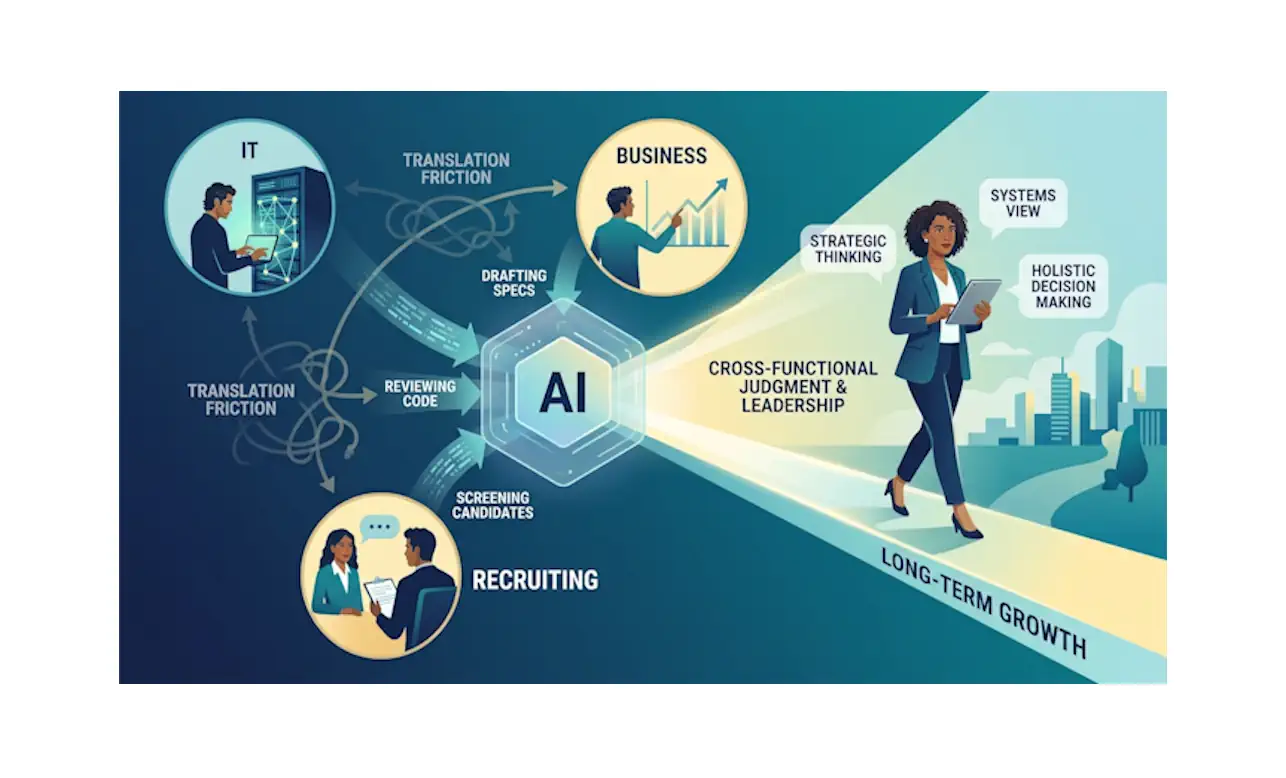
Now AI is chewing into all three roles at once. It writes code and reviews pull requests. It drafts requirements and turns vague business asks into structured specs. It screens résumés, ranks candidates, and increasingly conducts the first interview.
The instinct is to read this as: if AI erodes all three roles, then nobody wins — the whole triangle just shrinks toward zero, together.
I don’t think that’s quite right, and here’s why: the tension between these groups was never really about headcount. It was about translation. Each side existed partly to translate its domain to the others — IT translating technical risk into terms the business could weigh, recruiters translating market reality into terms both IT and the business could plan around. AI is extremely good at cheap, fast, literal translation. What it’s not good at is judgment under incomplete trust — deciding whose risk estimate to believe when the incentives to shade the truth are still human.
So the more likely outcome isn’t “no one wins.” It’s that AI removes the low-value friction — the requirements nobody read carefully, the résumé screening nobody enjoyed, the boilerplate code nobody wanted to write — and leaves behind a smaller number of people whose actual job becomes the thing that was always the real bottleneck: judgment, and trust, across the boundary.
The people who already cross over
You said it yourself: some people already cross over successfully. The engineer who can sit in a business review and speak in outcomes, not tickets. The business analyst who can read a technical design doc without panicking. The recruiter who actually understands what a “senior backend role” requires beyond keyword matching. These people have always been disproportionately valuable, and disproportionately rare, precisely because the system doesn’t reward crossing over — it rewards staying in your lane and defending it well.
That’s my honest take on where this goes: AI won’t resolve the uneasy relationship by making everyone equally obsolete. It’ll resolve it by making the lane-defenders obsolete faster than the lane-crossers, because lane-defense was mostly the low-value translation work AI now does for free. The people who survive and matter more will be the ones who were already doing what the “truce” was supposedly for — building actual trust across the boundary instead of relying on the structure to force cooperation.
The part that doesn’t change
Here’s the thing that AI doesn’t touch, and probably can’t: the mistrust in that triangle was never really about information quality. It was about incentives. IT has been burned by unrealistic asks; the business has been burned by missed deadlines; recruiters have been burned by hiring managers who reject every candidate and never say why. Better information doesn’t fix an incentive misalignment — it just makes the misalignment easier to see.
So if the AI future is going to genuinely resolve this, it won’t be because the tools got smarter. It’ll be because fewer, better-aligned people are left holding the relationship, with less noise to hide behind and less room to blame “the other side” for problems that were mutual all along. That’s not a guaranteed happy ending. But it’s a more honest one than “everyone loses” — and it’s the version I’d bet on.