We spend a lot of time talking about what AI will do to jobs.
Will it replace software developers? Lawyers? Accountants? Consultants? Designers? What happens to graduates entering the workforce when an AI system can perform much of the knowledge work that previously required years of education and experience?
These are important questions.
But I suspect they are only the beginning.
The more interesting question may be what happens if AI and robotics eventually make the production of many goods and services extraordinarily cheap.
Imagine a world where intelligent machines can design products, manufacture them, transport them, maintain the factories that produce them, and increasingly operate without human intervention. Imagine that AI can provide much of the world’s routine intellectual labour as well.
That would not simply be another technological revolution.
It could fundamentally change the relationship between work, money and scarcity.
From scarcity to abundance
Our economic systems have largely developed around scarcity.
We have limited resources and unlimited wants. We therefore need mechanisms for deciding who gets what, how resources are allocated, and what activities are worth pursuing.
Money is one of the mechanisms we use to solve this problem.
If something is scarce and people want it, we assign it a price. If you want more of it, you need more purchasing power.
But what happens when technology makes many things extraordinarily abundant?
If an AI can produce software almost instantly, software becomes cheaper.
If robots can manufacture physical goods with minimal human labour, manufacturing becomes cheaper.
If AI can generate education, analysis, entertainment and other forms of intellectual output at almost no marginal cost, those things may also become dramatically cheaper.
Push this far enough and you arrive at an extraordinary proposition: perhaps some things could eventually become so abundant that the traditional concept of price starts to lose meaning.
This is sometimes described as an “age of abundance.”
It is an exciting idea.
But it also raises a much bigger question.
If abundance becomes the norm, how does society organise itself?
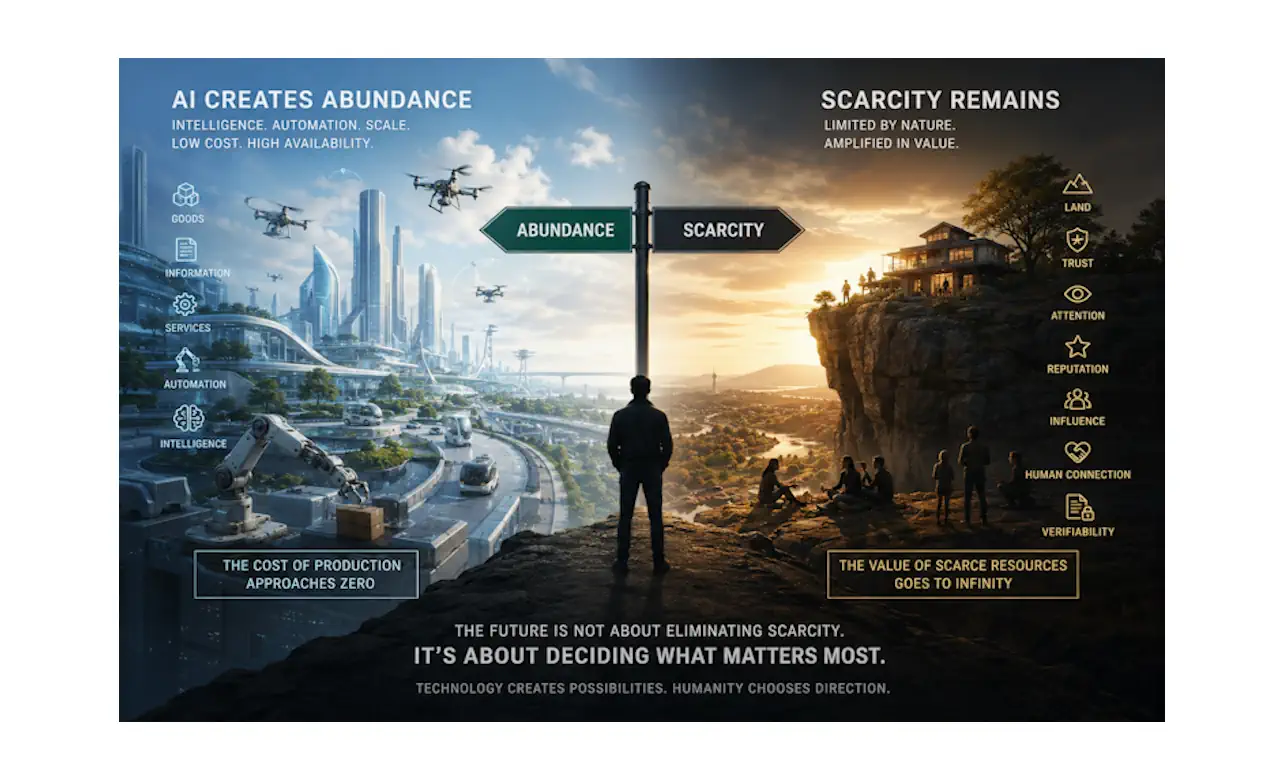
Scarcity doesn’t disappear
There is an important problem with the idea that technology simply eliminates scarcity.
Some things are not scarce because we lack sufficiently advanced technology.
They are scarce by their nature.
Land is one example.
There is only so much desirable land in Zurich, London, New York or Singapore. AI can make buildings cheaper to design and construct, but it cannot create another square kilometre of prime central land.
Attention is another.
There are billions of people producing content and an effectively unlimited amount of AI-generated material. But each person still has only 24 hours in a day.
Our attention therefore becomes more scarce as information becomes more abundant.
Trust is similar.
AI can generate millions of articles, images, videos, recommendations and claims. But the ability to determine which of those things deserves our trust does not automatically increase at the same rate.
Reputation, influence, access, status and genuine human relationships are also difficult to manufacture at scale.
In other words, abundance in one dimension can actually make scarcity in another dimension more important.
The problem doesn’t disappear.
Scarcity moves.
When information becomes abundant, trust becomes scarce
This is perhaps one of the most interesting consequences of AI.
AI is already making it dramatically cheaper to produce information. Soon, producing a convincing document, report, image, certificate or explanation may require almost no effort at all.
That creates an interesting reversal.
For much of the digital era, the problem has been getting enough information.
In an AI-abundant world, the problem may increasingly be determining which information we can trust.
Consider a regulated industry such as medical technology or manufacturing.
A certificate, declaration of conformity, training record or approval document may be used to make a consequential decision. The document itself might look perfectly legitimate.
But can you establish where it came from?
Has it been changed?
Who issued it?
Was it valid at the time it was relied upon?
Can its history be demonstrated months or years later?
AI doesn’t solve those problems. In some respects, it may make them harder.
If generating convincing documents becomes nearly free, then the value shifts from the document itself to the ability to verify its provenance and integrity.
This is one reason I find the emerging infrastructure around digital trust so interesting.
At Parowls Software, this is the problem we have been exploring: a lightweight verification layer that can sit alongside existing document management systems and electronic signatures, helping organisations establish the authenticity, integrity and provenance of critical documents.
The idea is not to replace the systems organisations already use. It is to make the history of an important digital document easier to verify when that document actually matters.
That may sound like a relatively narrow problem.
But perhaps it is part of a much bigger transition.
If AI makes the production of information abundant, then verifiability may become one of the scarce resources that matters most.
What happens to capitalism?
This creates an interesting challenge for our existing economic models.
Capitalism is extremely good at coordinating activity through prices. But prices work because things are scarce.
If the marginal cost of producing many goods and services approaches zero, the role of markets could change considerably.
That does not necessarily mean capitalism disappears.
Markets may remain extremely useful wherever scarcity persists.
But the things being traded may change.
Instead of primarily competing for manufactured goods or routine intellectual labour, people may increasingly compete for scarce assets such as desirable locations, experiences, attention, reputation, influence and access to decision-making.
The same could be true of digital systems.
If intelligence becomes abundant, access to trusted intelligence may become scarce.
If content becomes abundant, authenticity may become scarce.
If information becomes abundant, attention becomes scarce.
If production becomes abundant, ownership of the infrastructure that controls production may become extremely important.
That last point is particularly significant.
Abundance does not automatically mean equality.
A world where machines can produce almost anything could still be a world where a relatively small number of organisations control the machines, energy, compute, networks and infrastructure.
The technology could therefore create enormous abundance without necessarily distributing its benefits evenly.
That is where economics turns into politics.
Who governs abundance?
This is perhaps the question I find most fascinating.
If AI systems become sufficiently capable, we may eventually have to think about governance in very different ways.
There are already proposals for AI systems to be subject to forms of mutual oversight, with leading models or organisations checking one another and independent institutions acting as referees.
Whether such approaches ultimately work is another question.
But the underlying principle is interesting.
We are used to governments regulating companies, and companies regulating employees and customers. In an AI-driven economy, some of the most powerful actors may be systems that operate at a speed and scale that traditional institutions struggle to match.
How do you regulate something that can change faster than the regulation designed to control it?
Perhaps governance will increasingly require systems of continuous verification, independent oversight and competing checks and balances rather than simply rules written once and enforced afterwards.
That is a profound shift.
And then there is the human problem
There is another question that may ultimately be more difficult than economics or governance.
What happens to people when work stops being necessary?
For centuries, work has been more than a way of earning money.
It gives people structure.
It gives them status.
It provides social connections, achievement, identity and a sense that they are contributing something.
If machines eventually perform most economically valuable work, we may discover that employment was doing far more for society than simply producing goods and services.
What does happiness look like when your income is no longer dependent on having a job?
What gives someone status when professional achievement is no longer the primary measure?
How do people find purpose when survival no longer requires them to be economically productive?
These are not technical questions.
They are human ones.
And we have very little experience of answering them.
The paradox of abundance
Perhaps this is the central paradox.
AI could make many things abundant while making other things more valuable precisely because they remain scarce.
We may have almost unlimited intelligence but limited attention.
Almost unlimited content but limited trust.
Almost unlimited production but limited land.
Almost unlimited digital experiences but limited time.
And perhaps, most importantly, almost unlimited machine capability but limited human meaning.
That suggests that the future may not be a simple transition from scarcity to abundance.
It may instead be a transition from one economy of scarcity to another.
The scarce resources will simply be different.
And that could change what power means.
Today, economic power is often associated with ownership of capital, productive assets and scarce resources. In an AI-abundant world, power may increasingly come from controlling the systems that allocate access to what remains scarce.
That makes governance critically important.
The question is therefore not simply whether AI will make us richer, or whether it will eliminate jobs.
The deeper question is:
What kind of society do we build when intelligence and production become abundant, but land, attention, trust, influence and human time remain scarce?
We are still a long way from knowing the answer.
But perhaps we should start thinking about it now.
Because the most important consequences of AI may have surprisingly little to do with AI itself.
They may be about what happens to society when scarcity moves somewhere else.