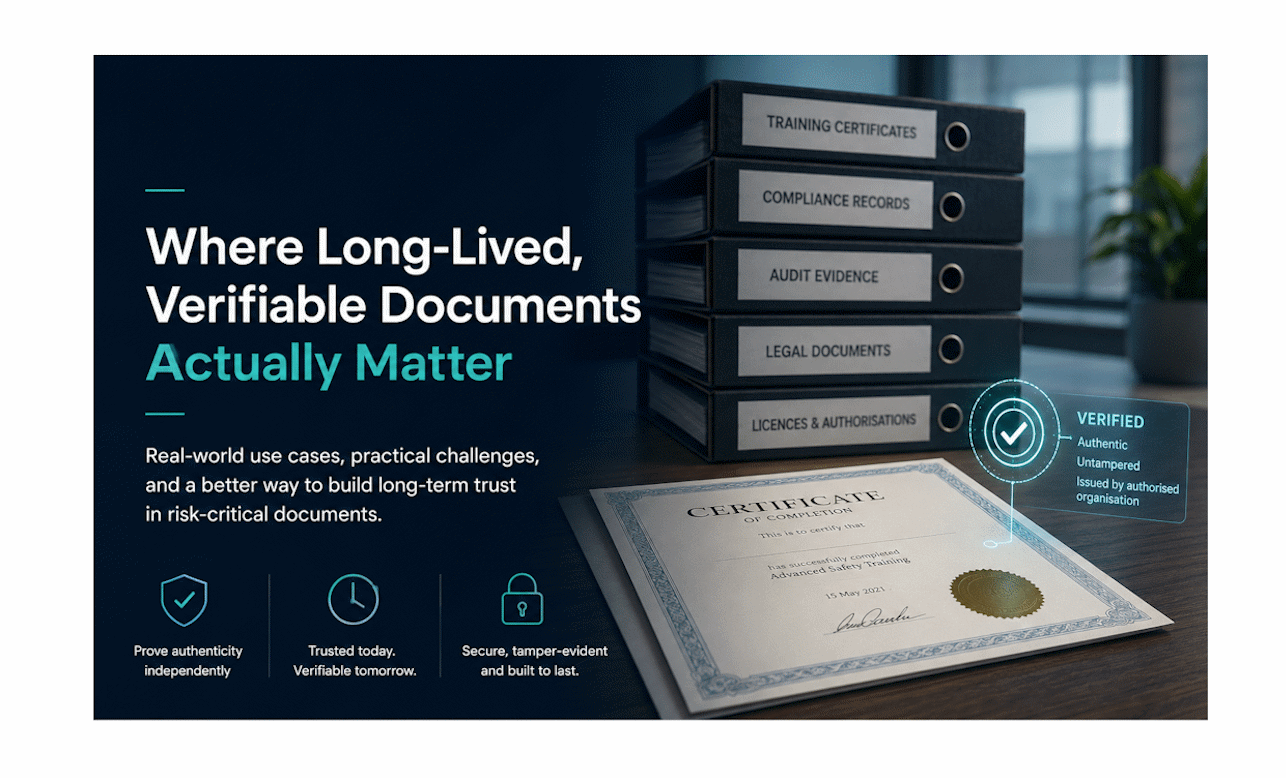
Organisations across regulated and compliance-driven sectors rely on risk-critical documents that must remain trustworthy for years — often decades. These include training certificates, compliance records, audit evidence, licences, and legal documents.
Yet despite widespread digitalisation, document verification is still largely manual. PDFs are emailed, signatures are visually inspected, and trust is assumed rather than proven. This creates operational drag, audit friction, and unnecessary risk.
In this post, we look at real-world use cases where long-lived, verifiable documents matter most, and why secure, independent document verification is no longer optional.
The Common Verification Problem
Across industries, the same verification pattern appears:
- A document is issued once
- It is relied on repeatedly over time
- Verification occurs under pressure (audits, onboarding, disputes)
- The original issuer is not always available
- Manual checks dominate due to lack of durable proof
The challenge is not document creation — it is maintaining trust over time.
1. Training Certificates and Professional Qualifications
Training certificates and professional qualifications are among the most frequently verified documents — and among the most fragile.
Common issues include:
- Certificates distributed as PDFs or paper
- Employers manually inspecting layout, logos, and signatures
- Issuers contacted by email or phone — if they still exist
- No reliable way to detect revocation or modification
This becomes critical when certificates relate to:
- Safety-critical roles
- Regulated professions
- Cross-border employment
Verifiable certificates allow third parties to independently confirm:
- Authentic issuance
- Document integrity
- Current validity status
Without contacting the issuer and without relying on visual inspection.
2. Compliance Records and Audit Evidence
Compliance and risk teams produce documents that must withstand scrutiny long after creation:
- Internal policies and procedures
- Control attestations
- Audit reports
- Third-party assurances
During audits or regulatory reviews, verification often depends on:
- File metadata
- Internal system trust
- Process explanations
These methods do not provide independent proof.
Secure document verification enables organisations to demonstrate:
- Document integrity
- Proven existence at a point in time
- Tamper detection
This strengthens audit readiness while reducing manual verification effort.
3. Company and Legal Documents
Many corporate records are legally and operationally critical:
- Board resolutions
- Shareholder decisions
- Contracts and annexes
- Powers of attorney
These documents may be reviewed years later during:
- Litigation
- M&A due diligence
- Regulatory or banking reviews
The risk is not just forgery, but uncertainty:
- Is this the final version?
- Has it been altered?
- Can its timeline be proven?
Long-term verifiable documents provide cryptographic evidence of integrity, supporting legal and compliance processes without replacing them.
4. Licences, Memberships, and Authorisations
Regulators and professional bodies issue documents that grant authority:
- Licences
- Membership confirmations
- Accreditations
Verification challenges increase when:
- Volumes grow
- Issuers restructure or cease operations
- Third parties require fast, reliable checks
Manual verification does not scale.
Self-verifiable documents allow relying parties to confirm authenticity without accessing internal systems or introducing vendor lock-in.
5. Cross-Organisational and Cross-Border Use Cases
Document verification becomes even harder when records move across:
- Organisations
- Jurisdictions
- Technical systems
Examples include:
- Education credentials used internationally
- Compliance evidence shared with partners
- Certifications required by foreign customers
In these cases, vendor-neutral, standards-based verification is essential. Trust must travel independently of platforms and issuers.
Why This Problem Persists
Most organisations still rely on:
- PDFs as final artefacts
- Email as a delivery mechanism
- Manual review as the last line of defence
Many proposed solutions fail because they:
- Require full platform replacement
- Create vendor lock-in
- Add complexity without long-term durability
For risk-critical, long-lived documents, verification must be:
- Additive, not disruptive
- Independent of the issuing system
- Durable over time
- Easy to explain to auditors and regulators
A Practical Path Forward
The goal is not to overhaul document workflows or introduce hype-driven technology.
The goal is to:
- Reduce manual verification work
- Improve confidence in long-lived documents
- Preserve existing formats and processes
- Enable independent, long-term verification
This is a practical, solvable problem — and one that delivers immediate operational value.
Call to Action
If your organisation relies on risk-critical documents that must remain trustworthy over time, we can help you make them tamper-evident and independently verifiable — without vendor lock-in or unnecessary complexity.
Talk to us about a small, low-risk pilot to verify certificates, compliance records, or other long-lived documents within your existing systems.
➡️ Secure long-term trust in your documents — pragmatically and without disruption.