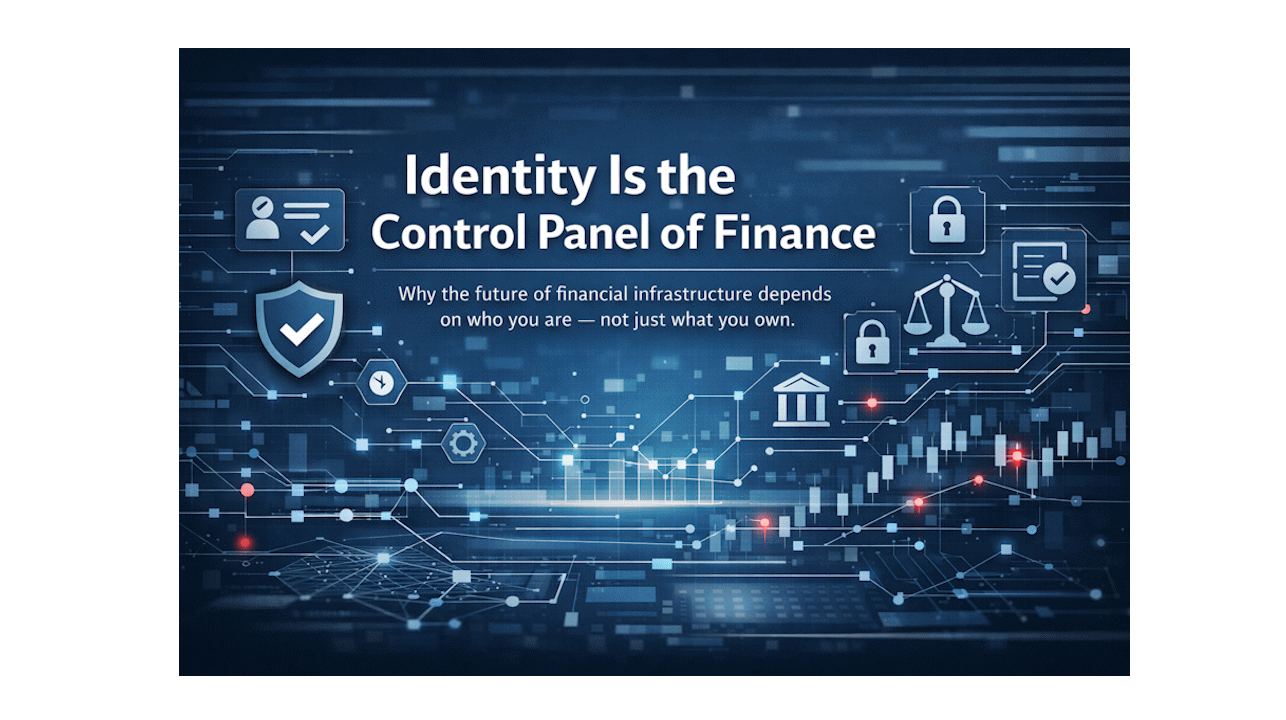
Why the Future of Financial Infrastructure Depends on Who You Are — Not Just What You Own
In the previous article, From TradFi to CryptoFi: Why Finance Is Becoming Infrastructure, we explored how finance is evolving from a collection of institutions into a shared, programmable operating environment.
That evolution raises a deeper question:
If assets move automatically and systems execute continuously, where does control actually sit?
The answer is not assets.
It is identity.
Not identity as a database of personal information, but identity as a rule-setting and permissioning mechanism that governs access, accountability, and enforcement across modern financial systems.
In short: identity becomes the control panel of finance.
1. Identification Is Not Optional — It Is Structural
Whenever you interact with a financial system, you are identified.
That is already true today:
- Opening a bank account requires identity verification
- Trading securities requires KYC and AML checks
- Holding assets through an institution creates legal relationships
- Taxation, sanctions, and enforcement all depend on attribution
None of this disappears in a blockchain-based or tokenised system.
What changes is how identity is used.
Instead of continuously exposing personal data to multiple intermediaries, identity becomes a selective, cryptographic proof mechanism — confirming eligibility, authority, or compliance without unnecessary disclosure.
The system does not need to know who you are in full.
It needs to know whether you are allowed to do this — right now — under these rules.
2. Identity as Infrastructure, Not Surveillance
Modern digital identity systems — such as the forthcoming Swiss e-ID (via the swiyu wallet, planned for rollout from 2026) — are not designed as tracking tools or central databases.
They function as state-backed issuers of verifiable credentials.
This allows individuals to prove statements such as:
- “I am a verified person”
- “I meet the regulatory requirements for this transaction”
- “I am authorised to access this service”
- “I fall within this legal or jurisdictional scope”
Crucially:
- Personal data is not written to blockchains
- Only cryptographic proofs are shared
- Disclosure is purpose-bound and minimal
- Credentials can be revoked or updated
- Control remains with the individual
The system proves truth, not identity records.
That distinction is what makes identity usable as infrastructure rather than surveillance.
3. Banks Still Know Your Assets — And They Must
A common misconception is that programmable finance eliminates institutional oversight.
It does not.
Banks, custodians, and regulated entities will always need to know:
- Assets they custody
- Positions they finance or underwrite
- Risks they assume
- Transactions they facilitate
- Exposures relevant to capital and liquidity rules
This is non-negotiable for:
- financial stability
- investor protection
- taxation
- sanctions enforcement
- criminal investigation
What changes is scope, not responsibility.
Institutions no longer need to know everything about a person — only what is relevant to their role in a specific transaction.
4. From Continuous Surveillance to Event-Based Compliance
Today’s financial system relies heavily on:
- continuous monitoring
- duplicated customer records
- retrospective audits
- permanent profiles
An infrastructure-based model shifts toward:
- pre-transaction verification
- event-based compliance
- purpose-bound disclosure
- cryptographic auditability
Instead of asking:
“Who are you, and what do you own at all times?”
The system asks:
“Are you permitted to do this, at this moment, under these conditions?”
Identity answers that question.
5. Public Infrastructure Does Not Mean Public Identity
Assets may exist on shared digital infrastructure.
That does not mean identities are public.
- Wallet addresses are not identities
- Visibility does not equal attribution
- Transparency does not remove due process
Identity is revealed only when legally required, through:
- regulated access points (banks, custodians, exchanges)
- lawful investigations
- court orders
- credential revocation mechanisms
In many cases, this is more precise and enforceable than today’s system — not less.
6. Where the Financial Information Actually Lives
When finance becomes infrastructure, information becomes deliberately modular.
a) Asset and transaction state
Stored on shared infrastructure (e.g. blockchains or DLT):
- ownership and transfer of assets
- transaction history
- smart contract state
This is the objective financial state machine.
b) Identity and personal data
Not stored on shared infrastructure:
- personal data remains with issuers (governments, banks)
- individuals hold credentials in wallets
- systems receive proofs, not raw data
c) Institutional records
Banks and regulators still maintain:
- accounts and exposures
- risk models
- reporting data
- audit trails
The difference is that institutions now observe and act on shared truth rather than reconciling private ledgers.
7. Who Writes the Software — and Who Decides?
There is no single “system” and no single author.
Financial infrastructure is built in layers:
- Core protocols: open-source communities and research-driven teams
- Standards: public–private bodies, governments, and regulators
- Smart contracts: financial institutions and infrastructure providers
- Custody and access systems: banks, wallet providers, hardware vendors
- Compliance tooling: RegTech firms and internal bank teams
- User applications: banks, fintechs, and enterprises
Decision-making is equally layered:
- Law defines what must exist
- Regulators define what is acceptable
- Institutions implement and remain liable
- Markets determine what survives
Code does not replace institutions.
It forces them to be explicit about their role.
8. The Changing Position of Banks and Regulators
Banks, regulators, and governments do not disappear.
Their positioning changes — structurally, not confrontationally.
They move from:
- data accumulation
- manual oversight
- fragmented systems
To:
- rule definition
- infrastructure governance
- automated enforcement
- real-time observability
Control is not lost.
It is codified.
9. Why Identity Is the Control Panel
Identity determines:
- who can access markets
- which rules apply
- what assets are eligible
- when disclosure is required
- how enforcement is triggered
- where accountability sits
Assets move automatically.
Processes execute automatically.
Identity defines the conditions under which this happens.
That is why identity — not assets — becomes the primary control surface of modern finance.
10. Finance as Infrastructure — Revisited
Finance is becoming infrastructure:
- faster
- interoperable
- increasingly automated
The trajectory is toward a greatly amended financial environment, where institutions adapt their roles to shared digital foundations rather than proprietary systems.
This is not a revolution.
It is an upgrade.
Where Parowls Fits
For most organisations, the challenge is not adopting blockchain or digital identity tomorrow.
It is understanding:
- how identity, assets, and compliance converge
- how responsibilities shift without disappearing
- how to prepare for infrastructure-level change before it becomes mandatory
At Parowls, we help organisations make sense of this transition — from identity and governance through to future-ready digital and financial architectures.
Understanding the control panel is the first step.