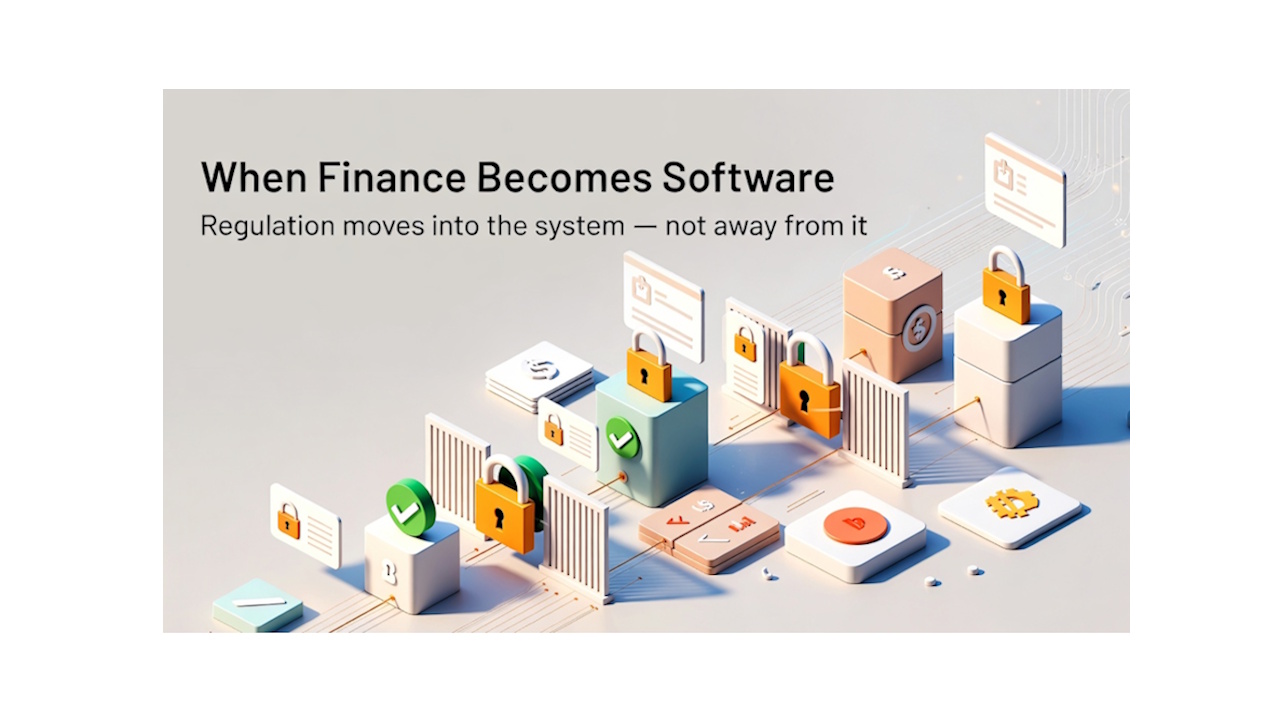
From institutional oversight to rule-based financial governance
Introduction: Regulation Has Not Failed — Its Object Has Changed
A common critique of blockchain-based financial systems is that they undermine regulation. If transactions are executed by software rather than institutions, and if financial services are distributed across interoperable systems rather than centralized within banks, how can oversight, accountability, and legal authority be preserved?
This concern is understandable, but it rests on a flawed assumption: that regulation must be exercised primarily through institutions in order to be effective.
Historically, regulation has never been about banks as such. It has been about control points — places where rules can be applied, enforced, and audited. For decades, banks fulfilled this role because financial activity was technically impossible without them. That technical constraint no longer holds.
What we are witnessing is not deregulation, but a re-architecting of regulatory enforcement, driven by software, cryptography, and programmable systems. Regulation is not disappearing; it is moving earlier in the transaction lifecycle, deeper into execution logic, and—when well designed—becoming more precise.
1. Why the Institutional Model of Regulation Worked
Traditional financial regulation evolved around centralized intermediaries because finance itself was centralized. Banks, custodians, clearing houses, and payment processors controlled customer onboarding, asset custody, transaction execution, and record-keeping.
This allowed regulators to exercise oversight indirectly by licensing institutions, mandating compliance procedures, auditing records after execution, and imposing sanctions for violations. The model worked because two conditions held:
- All meaningful financial activity passed through identifiable institutions
- Those institutions could be compelled to act as enforcement proxies
Where these conditions still apply, the model remains effective. Increasingly, however, they do not.
2. Financial Services Are Now Architecturally Fragmented
Modern financial systems—particularly those involving tokenization, blockchain settlement, and smart contracts—are no longer monolithic.
A single transaction may involve a decentralized identity provider, a regulated asset issuer, an on-chain settlement protocol, an off-chain compliance oracle, and a custodial or non-custodial wallet. Each component may be operated by a different legal entity, under a different jurisdiction, and subject to a different regulatory regime.
This fragmentation is not accidental. It mirrors the evolution of other digital infrastructures, most notably the internet, where modularity and interoperability replaced vertically integrated systems.
Crucially, fragmentation does not eliminate control. It redistributes it.
3. Why Regulating Institutions Alone Is No Longer Sufficient
When execution is automated and distributed, institution-centric oversight becomes incomplete for three structural reasons.
First, execution may occur without discretionary human intervention. Smart contracts do not interpret intent; they execute predefined logic deterministically.
Second, no single institution may control the entire transaction lifecycle. Responsibility becomes distributed across infrastructure providers, identity systems, rule engines, and data sources.
Third, post-hoc enforcement becomes less effective. Once an on-chain transaction is final, reversal is technically constrained and legally complex.
This does not imply lawlessness. It implies that regulation must move upstream—from supervision after execution to enforceable conditions before execution.
4. From Institution-Centric to Rule-Centric Oversight
In software-controlled systems, regulation increasingly defines what must be true before a transaction can occur, rather than relying solely on institutions to detect violations afterward.
This represents a fundamental shift in how oversight operates:
- Enforcement moves from post-transaction audits to pre-transaction constraints
- Compliance shifts from procedural reporting to executable conditions
- Trust in institutional discretion is supplemented by verifiable, inspectable rules
Smart contracts do not replace regulation; they instantiate it.
For example, a tokenized security can be engineered to transfer only between eligible wallets, enforce jurisdictional restrictions cryptographically, or implement legally mandated freezes upon instruction from an authorized authority.
In this model, regulatory control no longer rests primarily in bank charters, but in the integrity of the systems that execute regulated activity.
5. Real-World Regulatory Signals
Switzerland’s DLT Act (effective since 2021) explicitly recognizes ledger-based securities, allowing rights and obligations to be enforced through technical systems rather than paper-based registries. Legal validity is preserved; execution changes. This has enabled operational tokenized issuance and trading under FINMA oversight, with licensed DLT venues such as BX Digital now active.
The EU DLT Pilot Regime (launched 2023) similarly acknowledges that compliance can be embedded into systems rather than layered on top. However, uptake remains limited due to narrow asset scopes, low volume caps, and time-limited licenses. As of early 2026, industry participants are calling for rapid reform to prevent liquidity and innovation from migrating to more permissive jurisdictions.
Together, these examples show regulators experimenting not with less regulation, but with different enforcement architectures.
6. Compliance Moves Before Execution
In traditional finance, compliance is largely retrospective: transactions occur, data is reported, violations are detected, and penalties are applied.
In programmable systems, compliance increasingly precedes execution. Eligibility is verified, constraints are enforced, execution occurs only if conditions are met, and an immutable audit trail is produced by default.
When properly designed, this can enable stricter and more precise enforcement. However, outcomes depend critically on architecture, governance, and ongoing regulatory engagement.
7. Who Enforces the Rules When Software Executes Them?
A common fear is that “code replaces law.” This is incorrect.
Law continues to define legitimacy, authority, accountability, and sanctions. What changes is how those legal requirements are operationalized.
Regulators define permissible architectures and rule frameworks. Institutions implement and operate compliant systems. Software executes rules consistently and produces verifiable records.
In this configuration, software is not a sovereign authority—it is an instrument of enforcement.
8. Limits and Design Challenges
Executable compliance introduces real trade-offs. Immutability can hinder legal reversals; oracles introduce new dependencies; transparency can conflict with data protection; and liability attribution remains unresolved when automated logic produces unlawful outcomes.
Mitigations exist—hybrid architectures, governed upgrade paths, regulated oracles, privacy-preserving cryptography—but they require deliberate design and continuous regulatory dialogue.
These challenges do not invalidate the model. They define its engineering constraints.
9. Fragmentation Can Strengthen Oversight
When designed with compliance in mind, fragmented systems can enhance regulatory visibility. Cryptographic records are tamper-evident, execution logic is inspectable, and systemic risk is less concentrated.
Oversight shifts from auditing opaque balance sheets to observing system behavior directly—focusing on events rather than institutions.
Conclusion: Regulation Becomes Part of the System
As financial services become software-controlled and modular, regulation does not disappear. It becomes embedded—earlier, more precisely, and in some cases more effectively.
This is not a confrontational transition for banks, regulators, or governments. Their positioning is changing, not their relevance.
The future of financial oversight is not deregulated finance. It is architected regulation.
Where Parowls Fits
As financial systems evolve from institution-bound processes into software-defined, modular infrastructures, the central challenge is no longer whether regulation applies, but how it is translated into architecture.
At Parowls, we work at this intersection: where regulation, identity, governance, and technology converge. Our focus is not on deploying isolated blockchain components, but on helping organizations understand and design for the structural consequences of programmable finance.
This includes:
- Interpreting regulatory requirements as system-level constraints rather than procedural checklists
- Designing identity and compliance architectures that support ex-ante enforcement without sacrificing legal authority
- Supporting institutions and public bodies in navigating fragmented execution environments while maintaining accountability
- Preparing organizations for regulatory evolution, not just current compliance
The core risk in software-defined finance is not technical failure—it is architectural misalignment between law, execution, and governance. Strategic readiness means building systems that can absorb regulatory change, jurisdictional nuance, and legal intervention over time.
Regulation is adapting.
Financial systems are transforming.
Architectural preparedness determines who can operate safely—and sustainably—within them.