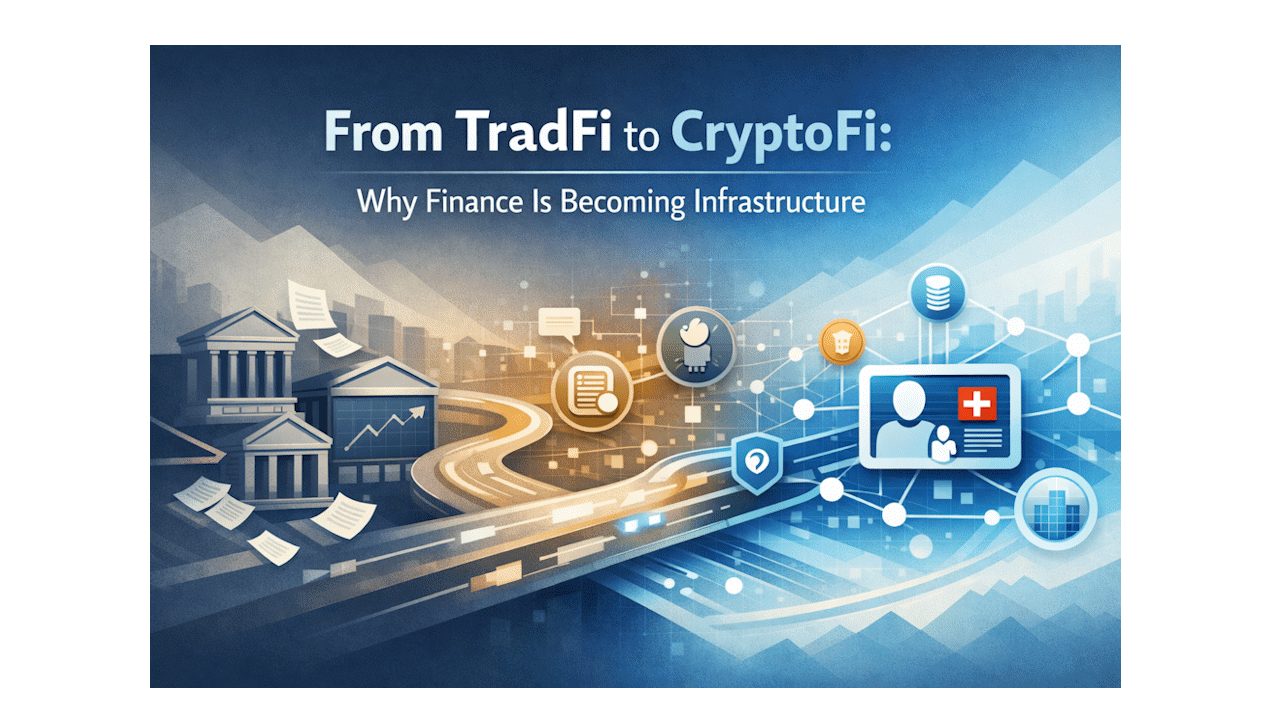
For years, the crypto industry has been described as “traditional finance with a digital asset attached.”
Exchanges look like brokerages. Lending protocols resemble banks. Stablecoins mimic money-market funds. At first glance, it’s easy to conclude that nothing fundamental has changed.
But that view misses the deeper structural shift now underway.
Crypto isn’t transforming finance by replacing banks or overthrowing regulators. It’s transforming finance by changing the underlying infrastructure — the rails on which assets move, settle, and interact. And once those rails change, the entire architecture of global finance begins to evolve in ways traditional systems simply cannot replicate.
This evolution isn’t theoretical. It’s already unfolding across Switzerland, the UK, and the EU — each shaped by different regulatory incentives, market structures, and geopolitical realities. And in Switzerland’s case, it increasingly intersects with the forthcoming Swiss e-ID, set to provide a state-backed, privacy-preserving identity layer for the next generation of financial infrastructure.
Let’s unpack what’s really changing.
1. TradFi’s Core Assumptions Are Being Rewritten
Traditional finance is built on a set of long-standing assumptions:
- Every transaction has intermediaries
- Settlement takes time
- Identity is centralized
- Markets are national
- Compliance is manual
- Financial products are siloed
Crypto rails challenge each of these foundations.
At their core, these rails are shared, programmable ledgers that allow assets, rules, and identity to interact directly — without requiring every step to be mediated by institutions.
Programmable Finance Replaces Manual Intermediation
Smart contracts automate functions historically handled by banks, brokers, and clearing houses. Loans can adjust automatically. Collateral can move in real time. Insurance can pay out instantly when predefined conditions are met.
Global Liquidity Replaces National Markets
Crypto markets operate 24/7, across borders, by default. Capital formation becomes global rather than geographically constrained.
Composability Replaces Siloed Products
Protocols connect like APIs. A lending protocol can rely on decentralized exchanges for pricing. A stablecoin can be backed by tokenized government bonds. Entire financial products can be assembled modularly, rather than built end-to-end by a single institution.
Machine-to-Machine Finance Emerges
AI agents can borrow, lend, hedge, and rebalance autonomously. This is largely impossible in traditional finance, which is built around human identity and manual processes.
Identity Becomes Programmable
With decentralized identity and verifiable credentials, markets can move beyond pure over-collateralization. Reputation, verified income streams, and credentials can all be used — without exposing personal data.
Much of this will happen invisibly, behind familiar financial products — just as TCP/IP powers the internet without most users ever needing to understand it.
These technical shifts don’t occur in a vacuum. Geopolitics actively shapes how — and how fast — they spread.
2. Geopolitics Doesn’t Block Crypto — It Shapes It
A common argument is that crypto can’t transform finance because nation-states will never agree on a shared system. But technological adoption has never worked that way.
Countries don’t adopt new infrastructure because they agree.
They adopt it because they can’t afford not to.
States Adopt Crypto Rails for Self-Interest
- Cheaper and faster settlement
- Reduced dependency on foreign banking infrastructure
- More competitive capital markets
- Attraction of global talent and investment
Protocols Become Neutral Infrastructure
Like the internet itself, crypto rails don’t belong to any single country. Rival states can use the same infrastructure without trusting each other.
Institutions Move Because Competition Forces Them
If one financial center settles tokenized assets faster and cheaper, liquidity follows. Market pressure — not ideology — drives adoption.
AI Accelerates Everything
Machine-to-machine transactions don’t care about borders. They care about latency, liquidity, and cost. Crypto rails outperform on all three.
3. How This Plays Out in Switzerland, the UK, and the EU
Switzerland: A Neutral, High-Trust Tokenization Hub
Switzerland’s DLT Act and FINMA’s clarity around custody and tokenized assets — including recent DLT trading venue licenses — make it one of the most mature environments for institutional adoption.
The trajectory is pragmatic:
- Banks integrate crypto custody and tokenized securities
- Settlement and collateral management quietly move on-chain
- High-value assets (funds, real estate, private equity) are tokenized under Swiss law
- The Swiss e-ID, with rollout commencing in 2026, is poised to become a trusted identity layer for compliant on-chain interactions
This approach aligns with Switzerland’s long-standing role as a neutral intermediary in global finance.
Switzerland doesn’t aim to dominate crypto.
It becomes the legally robust, high-trust venue where serious institutions issue and hold tokenized assets.
United Kingdom: Programmable Capital Markets
Post-Brexit, the UK is positioning itself as agile and innovation-friendly:
- FCA-regulated stablecoins for payments
- Tokenized securities integrated into London’s markets
- AI-driven trading accessing on-chain liquidity
The goal is speed and flexibility — while maintaining global credibility.
European Union: Harmonised, Regulated Crypto Infrastructure
With MiCA, the EU creates a single regulatory layer:
- Licensed exchanges and custodians
- Euro-stablecoins for payments
- Tokenization within existing banking frameworks
- Compliant, permissioned DeFi inside the single market
The EU prioritises scale, control, and standard-setting over speed.
4. The Swiss e-ID: The Bridge Between TradFi and CryptoFi
Identity is the missing link between regulated finance and programmable finance.
The Swiss e-ID — set to launch in mid-2026 via the Swiyu wallet — will provide:
- State-verified identity
- Privacy-preserving authentication
- Cryptographic signatures
- Compatibility with smart contracts and digital assets
This enables:
- Automated KYC and AML
- Compliant access to tokenized securities
- Reputation-based financial products
- Secure digital onboarding
- Cross-border interactions using verifiable credentials
Crucially, the Swiss e-ID is not a surveillance tool.
It allows individuals to prove specific facts — such as being a verified person or meeting regulatory criteria — without revealing unnecessary personal data.
It’s not just a digital passport.
It’s a foundational layer for future financial infrastructure.
5. The Real Transformation: Finance Becomes Infrastructure
The shift from TradFi to CryptoFi isn’t about replacing banks with blockchains. It’s about turning finance into programmable infrastructure that:
- Settles instantly
- Operates globally
- Integrates identity
- Supports AI agents
- Reduces intermediaries
- Increases transparency and auditability
- Enables entirely new financial products
Banks, regulators, and governments remain central — but the rails they operate on become faster, smarter, and interoperable.
CryptoFi doesn’t overthrow TradFi.
It upgrades it.
The organisations that recognise this early will help shape how that upgrade is implemented.
And Switzerland — with its legal clarity, financial reputation, and the forthcoming Swiss e-ID — is positioned to play a disproportionately influential role in that evolution.
Where Parowls Fits
For most organisations, the challenge isn’t adopting crypto rails tomorrow.
It’s understanding what becomes possible — and what becomes necessary — when finance turns into infrastructure.
At Parowls, we help organisations understand, prepare, and design for this transition: from identity and governance through to compliant, future-ready digital architectures.
The rails are changing.
Being ready is a strategic decision.