Most organisations don’t fail because of bad governance.
They fail because governance never reaches the point where real work happens.
Swiss SMEs excel at defining responsibilities, controls, and standards. Yet even with strong governance, daily operations often drift back to email threads, spreadsheets, and undocumented decisions. The gap isn’t strategic — it’s operational. And it’s costly.
Why Good Governance Breaks Down in Practice
Even well-designed governance frameworks falter when:
- Tools are selected before processes are clarified
- Responsibilities exist on paper but not in workflows
- Systems are technically correct but operationally awkward
- Teams revert to manual work during pressure moments
The result is familiar: more technology, but the same ambiguity.
Governance stays in documents; execution happens elsewhere.
The SME “Last Mile” Problem
Large enterprises can absorb inefficiency. SMEs cannot.
When execution breaks down, the impact is immediate:
- Disputed invoices
- Missing approvals
- Duplicate data entry
- Stressful audits
- Manual reconciliations
These aren’t technical failures — they’re coordination failures.
Everyone agrees on the rules, but no one shares a verifiable record of what actually happened.
This is where governed digital workflows — sometimes supported by lightweight blockchain verification — close the gap.
A Practical Path from Rules to Reliable Workflows
1. Start with One Workflow That Already Hurts
Don’t digitise everything. Fix one friction point first:
- Invoice approval
- Contract versioning
- Delivery confirmation
- Compliance documentation
Blockchain can anchor key evidence here without replacing existing systems.
2. Make Ownership Unambiguous
Every workflow must clearly define:
- Who submits
- Who approves
- Who validates
- Who corrects
Traceability reinforces accountability — and blockchain makes critical steps tamper-evident.
3. Build Verification Into the Process
People don’t need to agree on opinions.
They need to agree on facts:
- When an invoice was approved
- Which contract version was signed
- Who authorised a change
Swiss SMEs increasingly use hybrid models: operational data in familiar tools, with cryptographic proofs for key events.
4. Keep Complexity Invisible
Users shouldn’t need to understand governance models or cryptography.
Effective systems feel simple — and reduce uncertainty rather than add it.
Why Swiss SMEs Are Uniquely Positioned
Swiss organisations already operate with:
- Clear roles and responsibilities
- Strong legal obligations
- High accuracy standards
- Low tolerance for ambiguity
Digital workflows that reinforce these strengths — incrementally and pragmatically — deliver measurable reliability. Blockchain fits best as a quiet verification layer, not a headline feature.
What Happens When Governance Becomes Execution
SMEs that close the last-mile gap typically see:
- Fewer disputes
- Faster resolutions
- Easier audits
- Clearer accountability
- Lower operational stress
Without this transition, governance becomes overhead — and tools gather dust.
How Parowls Software Makes Governance Operational
At Parowls Software GmbH, we specialise in turning governance into daily practice:
- We start with your real workflows
- We design around clear responsibilities
- We apply technologies like blockchain only where they reduce friction
- We ensure alignment with Swiss legal and regulatory standards
Our goal is simple: make your governance work where your people work.
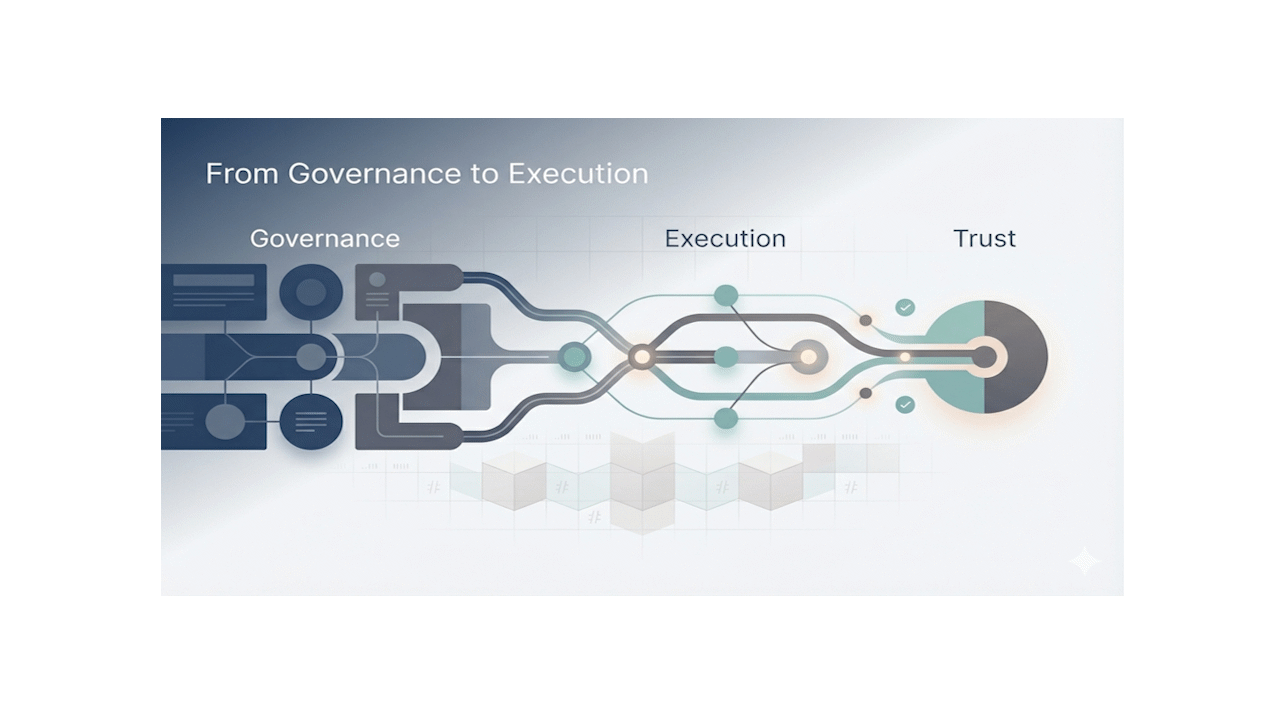
Governance Sets Direction. Execution Builds Trust.
If you want your governance to produce clarity — not just documentation — we can help you build workflows that deliver reliable, verifiable execution every day.
When you’re ready to bridge the last mile, Parowls Software is ready to support you.