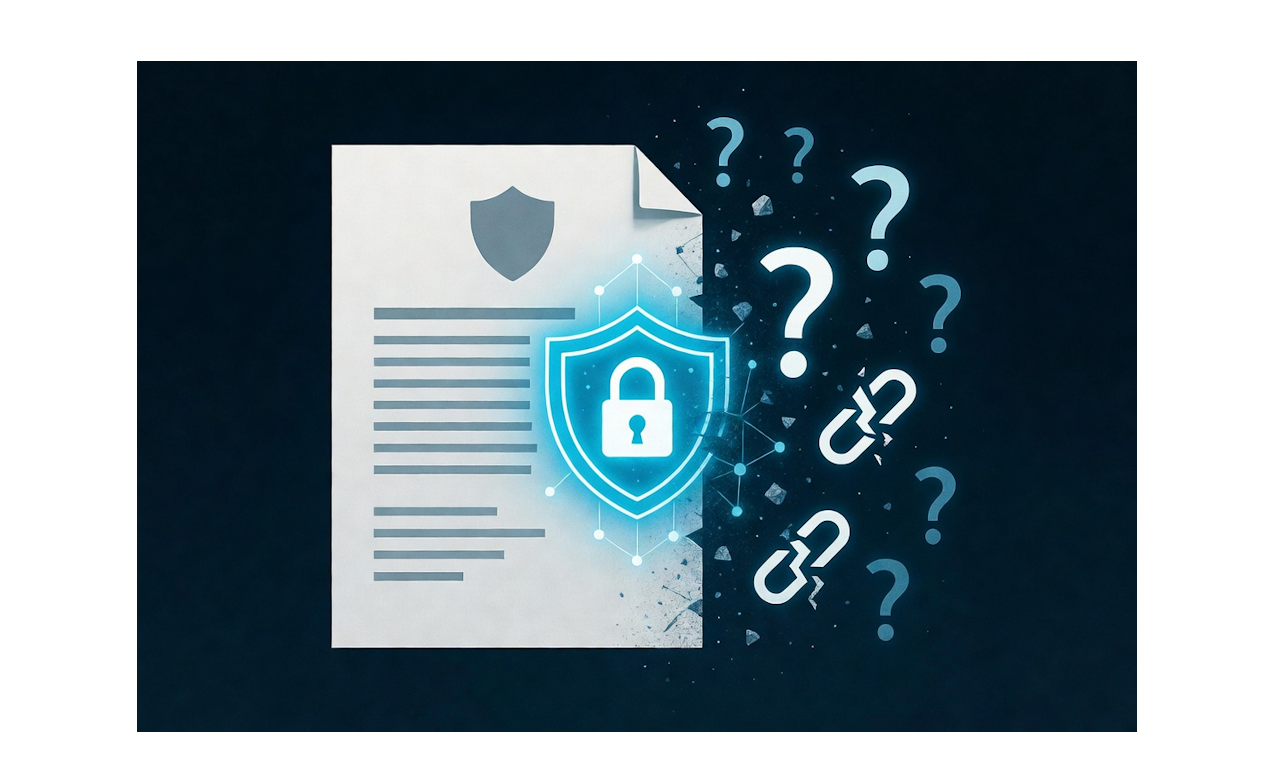
How Swiss companies in regulated industries are quietly paying for trust gaps — and what a lightweight trust layer can do about it.
In Switzerland, trust is deeply embedded in our business culture. We generally trust our institutions, our partners, and our established processes. This is one of our country’s great strengths.
However, this trust still carries hidden operational costs — especially in regulated sectors such as MedTech, pharmaceuticals, manufacturing, and compliance-driven services.
Every day, organisations rely on critical documents: supplier certificates, declarations of conformity, test reports, training records, design approvals, and audit evidence. While these documents are usually trustworthy, proving their authenticity, integrity, and provenance quickly and reliably often turns out to be surprisingly difficult.
This creates trust gaps — situations where organisations assume a document is correct, but lack an efficient, independent way to verify it when it matters.
The Real, Everyday Costs
These trust gaps rarely make headlines, but they create measurable friction:
- Quality Assurance teams spend hours manually verifying supplier certificates and chasing confirmations.
- Audit preparation becomes time-consuming and stressful when teams must reconstruct document histories across multiple systems.
- Supplier onboarding and change management processes are delayed because verifying external documents is cumbersome.
- Version control issues arise regularly (“Was this the exact version approved?”).
- Documents archived or deleted after legal retention periods leave organisations unable to easily prove they existed and were valid at a critical moment.
The result is higher operational cost, longer cycle times, and unnecessary risk — even though no actual fraud has occurred.
Why Existing Systems Don’t Fully Close the Gap
Swiss companies have invested significantly in professional tools: Enterprise Document Management Systems, Quality Management Systems, ERP platforms, qualified electronic signatures, and strict access controls.
These systems are very good at answering questions such as:
- Where is the document stored?
- Who accessed or approved it?
- When was it uploaded?
However, they often struggle with more fundamental questions once a document leaves the organisation or ages over time:
- Did this document truly originate from the claimed issuer?
- Has its content remained unchanged since approval?
- Is this the correct and still valid version?
- Can we independently prove its provenance years later — even if the original system is no longer accessible?
Qualified electronic signatures provide strong legal protection, but they are not always the most practical tool for high-volume, operational verification. This leaves many organisations still relying on manual processes for day-to-day trust decisions.
A Lightweight Trust Layer – Designed for the Swiss Reality
In a federal country like Switzerland, large-scale, multi-stakeholder blockchain infrastructures face major challenges. Coordinating cantons, municipalities, and numerous organisations, while managing governance, operations, key management, and integrations, is extremely complex. Many such initiatives only make sense with broad adoption, which can take years.
This is why we believe a lightweight, complementary trust layer is a more pragmatic solution for Swiss organisations today.
Instead of replacing existing systems or requiring a large network effect, this approach adds an independent verification capability that works alongside what you already have:
- Your DMS and QMS
- Qualified electronic signatures
- Future Verifiable Credentials (such as swiyu)
The original document can remain fully under your control — or even be archived or deleted later. Only a secure cryptographic proof is stored, allowing fast, independent verification of authenticity, integrity, and provenance whenever needed.
Where This Creates Real Value
Organisations we work with typically benefit most in the following areas:
- Supplier and material certificate verification — reducing manual checks and onboarding delays.
- Engineering change and approval workflows — ensuring clear version history.
- Training and qualification records — maintaining provability over years.
- Audit readiness — making it significantly easier to provide trustworthy evidence.
The result is not revolutionary disruption, but practical operational improvement: less manual work, faster processes, and stronger compliance confidence.
Trust Should Be Practical, Not Just Assumed
In Switzerland, we benefit from a high baseline of institutional trust. The goal is not to replace this trust, but to make it more efficient and resilient in daily operations and over the long term.
A lightweight trust layer does exactly that. It allows organisations to move from “we trust this document” to “we can quickly and independently verify this document” — without introducing heavy new infrastructure or complex consortium models.
This approach is deliberately Swiss in character: pragmatic, focused on real problems, and respectful of existing systems and processes.
The Future of Trusted Documents
As supply chains become more global and regulatory requirements more demanding, the ability to efficiently verify critical documents will become a competitive advantage.
Documents will increasingly evolve from simple files into trusted digital assets that carry their own verifiable history.
Organisations that adopt practical trust technology early will reduce risk, increase agility, and strengthen their reputation for reliability and compliance.
About Parowls
Parowls Software GmbH develops lightweight trust solutions that help regulated organisations verify the authenticity, integrity, and provenance of critical documents. Our focus is on practical integration, minimal disruption, and real operational value — enabling Swiss companies to strengthen trust without unnecessary complexity.